We recently attended a math conference, with keynote speaker Dr. Lisa Lunney. There, she talked about "Indigenous Ways of Knowing". We often think of things like Pi as being something the Greeks discovered, and therefore, only they could understand it. However, Dr. Lunney discussed how a Mi'kmaq elder in her community used a traditional method to make a perfect circle for her quillbox, using three lengths of wood strips and a thumb width...Pi, anyone? Her blog, Show Me Your Math, looks at how these traditional "Ways of Knowing" can be incorporated into the classroom.
My main takeaway from the conference had to do with the idea of not always focusing on Eurocentric knowledge in topics like math. After all, the Indigenous people of this land used math in THEIR everyday lives, too. Whether it was to determine how much food was "enough", how to create intricate patterns, or how to build a dwelling, people living in North America prior to the arrival of Europeans relied on their own mathematics, developed over generations. I believe that these understandings should be celebrated. The First Peoples of this land survived treacherous winters and untold perils, which is a testament to their knowledge and wisdom...and is worth teaching to our younger generations!
Tuesday, 28 March 2017

Thursday, 16 February 2017
Outdoor Learning
It is important to get out of the classroom and enjoy the outdoors. We were very fortunate to visit a nearby hiking trail at McLean's Park for orienteering and snowshoeing.
The benefits of being outdoors include:


The benefits of being outdoors include:
- Physical exercise.
- Refining motor control
- Learning about the natural environment and the creatures that inhabit them.
- Providing calm and focus.
- Learning is more memorable and engaging.


Wednesday, 25 January 2017
Wonder Wall

In my kindergarten classroom, my students were always making "I wonder ..." statements. I noticed that my grade 5/6 students did not. In an effort to encourage my students to wonder we began "Wonder Wednesdays". I got the idea from Collaboration and Comprehension by Stephanie Harvey and Harvey "Smokey" Daniels (I love this book!).
Students are invited to post any inquiry questions, even off-task questions, on a post it note and affix it to our Wonder Wall. On Wednesdays we take 15 - 30 minutes to address our wonder questions. The students are already demanding more time for their wonders.
Wonder Walls are a great entry point for those who are not yet comfortable with inquiry.
Wednesday, 23 November 2016
Collaboration is Delicious!
We just finished group science projects. During research time in the classroom, students would often appear to be unfocused and not get a lot accomplished. Moreover, some students complained about members of the group being silly and not contributing. I thought, "Ugh!" My first attempt at small group inquiry was not a success.
To help students assume individual accountability, I implemented the collaboration lesson, "Making and Using a Work Plan," from Comprehension and Collaboration by Stephanie Harvey and Harvey Smokey Daniels.
Students were given the task of baking and decorating a cake. After organizing themselves into groups, students were provided with a Work Plan Form. On the form students identifed the group members, their task, who was responsible for brining certain materials and doing specific tasks, and what help they would need from the teacher. Students were required to sign the form as a sign of commitment.
The next day, students followed the work plan to bake and decorate a cake a small group. They collaborated exceptionally well, had fun, and enjoyed a tasty treat!
I can't wait to have students use the work plan form to help them with their next small group inquiry!


To help students assume individual accountability, I implemented the collaboration lesson, "Making and Using a Work Plan," from Comprehension and Collaboration by Stephanie Harvey and Harvey Smokey Daniels.
Students were given the task of baking and decorating a cake. After organizing themselves into groups, students were provided with a Work Plan Form. On the form students identifed the group members, their task, who was responsible for brining certain materials and doing specific tasks, and what help they would need from the teacher. Students were required to sign the form as a sign of commitment.
The next day, students followed the work plan to bake and decorate a cake a small group. They collaborated exceptionally well, had fun, and enjoyed a tasty treat!
I can't wait to have students use the work plan form to help them with their next small group inquiry!


Saturday, 12 November 2016
Global Read Aloud
Our class has been particpating in the Global Read Aloud. It is a global literacy initiative founded by Pernille Ripp. It has connected more than 2 000 000 students in 60 different countries. Pernille's goal is to have one book to connect the world.
For six weeks, our class read Pax by Sara Pennypacker. It is the story of a twelve year old boy who is forced to abandon his domesticated fox when his father decides to join the approaching war. Students enjoyed the story and liked how the chapters alternated between the perspectives of the boy and the fox.

Using Edmondo, our class made a connection with Mrs. Ballard's grade 5 class in Texas. We used Google Hangouts to meet and discuss the book with each other on several occasions.
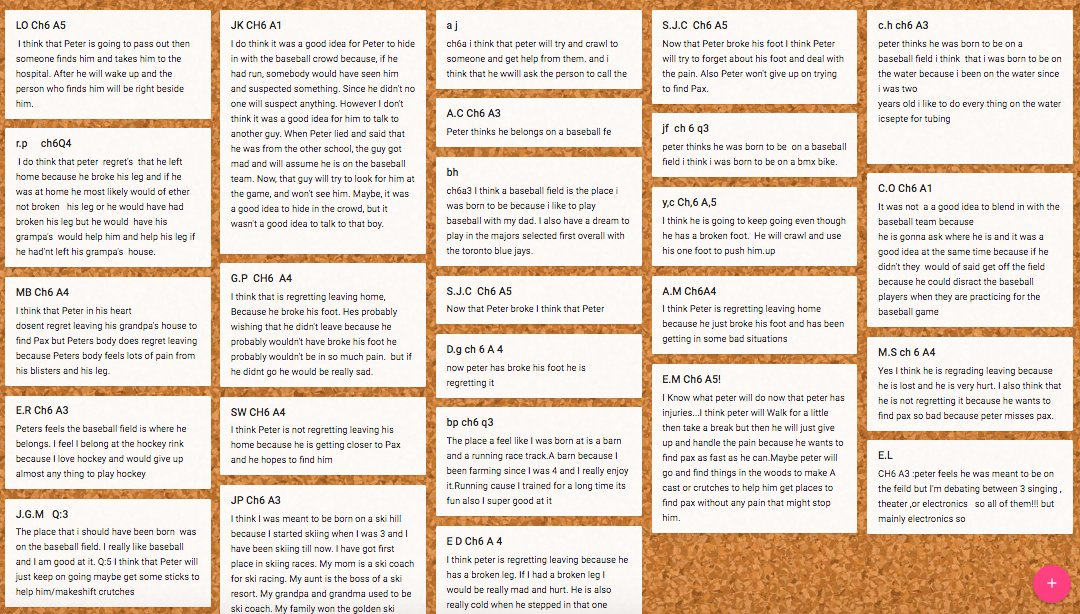
 Students would sometimes reply to questions posed by another class using a Padlet and we would tweet the Padlet. It provided an authentic audience for the students.

The Global Read Aloud was a great experience and we can't wait to find out which books will be featured next year.
For six weeks, our class read Pax by Sara Pennypacker. It is the story of a twelve year old boy who is forced to abandon his domesticated fox when his father decides to join the approaching war. Students enjoyed the story and liked how the chapters alternated between the perspectives of the boy and the fox.

Using Edmondo, our class made a connection with Mrs. Ballard's grade 5 class in Texas. We used Google Hangouts to meet and discuss the book with each other on several occasions.
 |
| Our class using Google Hangouts to discuss Pax with Mrs. Ballard's class in Texas. |
We also used #GRA16, #PaxSlowChat, and #GRAPax on Twitter to regularly communicate with others.

The Global Read Aloud was a great experience and we can't wait to find out which books will be featured next year.
Thursday, 3 November 2016
Campfire
We have begun to have campfires in our classroom. Campfires are sharing circles.
Sharing circles are a part of the oral tradition of the Anishinaabe. Usually a talking stick is used in the circle when meetings take place or decisions need to be made. A talking stick gives the speaker courage to speak the truth and the power to speak from the heart. When a person is holding the talking stick, he/she speaks from the heart without interruption. Other people in the circle listen respectfully to the speaker. Everyone in the circle gets a chance to hold the talking stick and share his/her thoughts and feelings. If somone chooses not to speak, he or she passes the stick to the next person until the stick has been passed to everyone participating.
In our classroom, we have adapted the sharing circle into a campfire with brags and drags. When I say, "Campfire", the students arrange themselves into a circle. Sitting in a circle helps to build a sense of community. We use a rock instead of a a talking stick to pass around the circle. Students are only allowed to talk when he/she is holding the rock, otherwise they are listening. Everyone is encouraged to share, but has the right to "pass". Students share 2 pieces of information (2 brags, 2 drags, or 1 brag and 1 drag). Brags are good things things that are happening to us and drags are not very happy things. The rock is passed in a clockwise direction or as the sun rises and sets as is the custom in the Anishinaabe tradition.

Campfires or Sharing Circles are helpful in building positive relationships with students. It allows me find out how each student is doing. I might learn about an exciting hockey game played the night before or an upcoming trip. I may also learn about things that are bothering students, such as a sick pet or a disagreement with a sibling. Students also have the opportunity to learn more about me when I share. Most of my brags and drags involve my two daughters. The students seem to be more kind when the discover I have had a bad morning because my family slept in and my kids missed the bus.
Sharing circles are a part of the oral tradition of the Anishinaabe. Usually a talking stick is used in the circle when meetings take place or decisions need to be made. A talking stick gives the speaker courage to speak the truth and the power to speak from the heart. When a person is holding the talking stick, he/she speaks from the heart without interruption. Other people in the circle listen respectfully to the speaker. Everyone in the circle gets a chance to hold the talking stick and share his/her thoughts and feelings. If somone chooses not to speak, he or she passes the stick to the next person until the stick has been passed to everyone participating.
In our classroom, we have adapted the sharing circle into a campfire with brags and drags. When I say, "Campfire", the students arrange themselves into a circle. Sitting in a circle helps to build a sense of community. We use a rock instead of a a talking stick to pass around the circle. Students are only allowed to talk when he/she is holding the rock, otherwise they are listening. Everyone is encouraged to share, but has the right to "pass". Students share 2 pieces of information (2 brags, 2 drags, or 1 brag and 1 drag). Brags are good things things that are happening to us and drags are not very happy things. The rock is passed in a clockwise direction or as the sun rises and sets as is the custom in the Anishinaabe tradition.

Campfires or Sharing Circles are helpful in building positive relationships with students. It allows me find out how each student is doing. I might learn about an exciting hockey game played the night before or an upcoming trip. I may also learn about things that are bothering students, such as a sick pet or a disagreement with a sibling. Students also have the opportunity to learn more about me when I share. Most of my brags and drags involve my two daughters. The students seem to be more kind when the discover I have had a bad morning because my family slept in and my kids missed the bus.
Thursday, 27 October 2016
Infusing Indigenous Perspectives into Mathematics and Science
 Thanks to ETFO, Joanne and I were able to travel to Toronto to attend a conference on Infusing Aboriginal Perspectives into Science and Mathematics. Over the course of two days, we had the opportunity to learn from other educators, try science and math activities, and review resources to help bring Indigenous culture into our classrooms.
 Beading is a great way to teach patterning and algebra to elementary students. It was an engaging, yet sometimes frustrating, activity with opportunities for rich learning. Planning out the design in advance proved challenging for many of the teachers at the conference. I personally went through three planning sheets before I finally decided on my pattern!

We also explored some flight concepts, through the design of a blunt-tipped arrow. I'm sure anyone who has taught grade 6 in Ontario has done some hands on building of paper planes...this activity was a way to explore Indigenous culture and cover the Science and Tech curriculum at the same time! I think one way to make this experience more authentic would be to include an exploration of traditional materials and tools for arrow building (with safety in mind, of course). What type of wood/branches would work best? What tools would Indigenous people have used to shape their arrows? What types of feathers would they have used, depending on where they lived? The learning potential is unlimited!
Overall, it was a fun experience...Thanks, ETFO!
Subscribe to:
Posts (Atom)