Friday, 19 May 2017

Water Walk 2017 & Picking Up Our Bundles


We were very fortunate to have a visit from Norma Peltier and Edward George today. Norma is a part of For the Earth and Water Walk 2017 and Edward is a part of Picking Up the Bundles Canoe Journey.

For the Earth and Water Walk is an initiative of respected Anishinaabe Elder, Josephine Mandamin.  Josephine has walked countless kilometers along shorelines and endured all kinds of weather praying for water.  Her current Water Walk began on Spirit Mountain, Deluth, Minnesota and will continue along the Great Lakes to Mantane, Quebec, on the Saint Lawrence Seaway.

Picking Up the Bundles Canoe Journey is a cermonial canoe journey that moves in support and solidarity with For the Earth and Water Walk 2017.  


Norma and Edward explained the significance of the Water Walk and Canoe Journey, shared the route, and explained some of the protocols.  It was explained that when they are walking for water they are in Ceremony until they reach their destination.  Women are responsible for making the offerings and wear long skirts to show respect for Mother Earth.  Men do not carry the water, but help by carrying the Eagle Feather Staff and providing protection on the busy road ways.  The water, filled in Deluth, is carried in the copper pot. 


Norma and Edward offered tobacco to the students.  The students held the tobacco in their hands while thinking good thoughts for healthy water.  Norma and Edward collected the tobacco and wrapped it in a red cloth to take with them to offer to the water.


Friday, 12 May 2017

Indigenous Games with KTEI


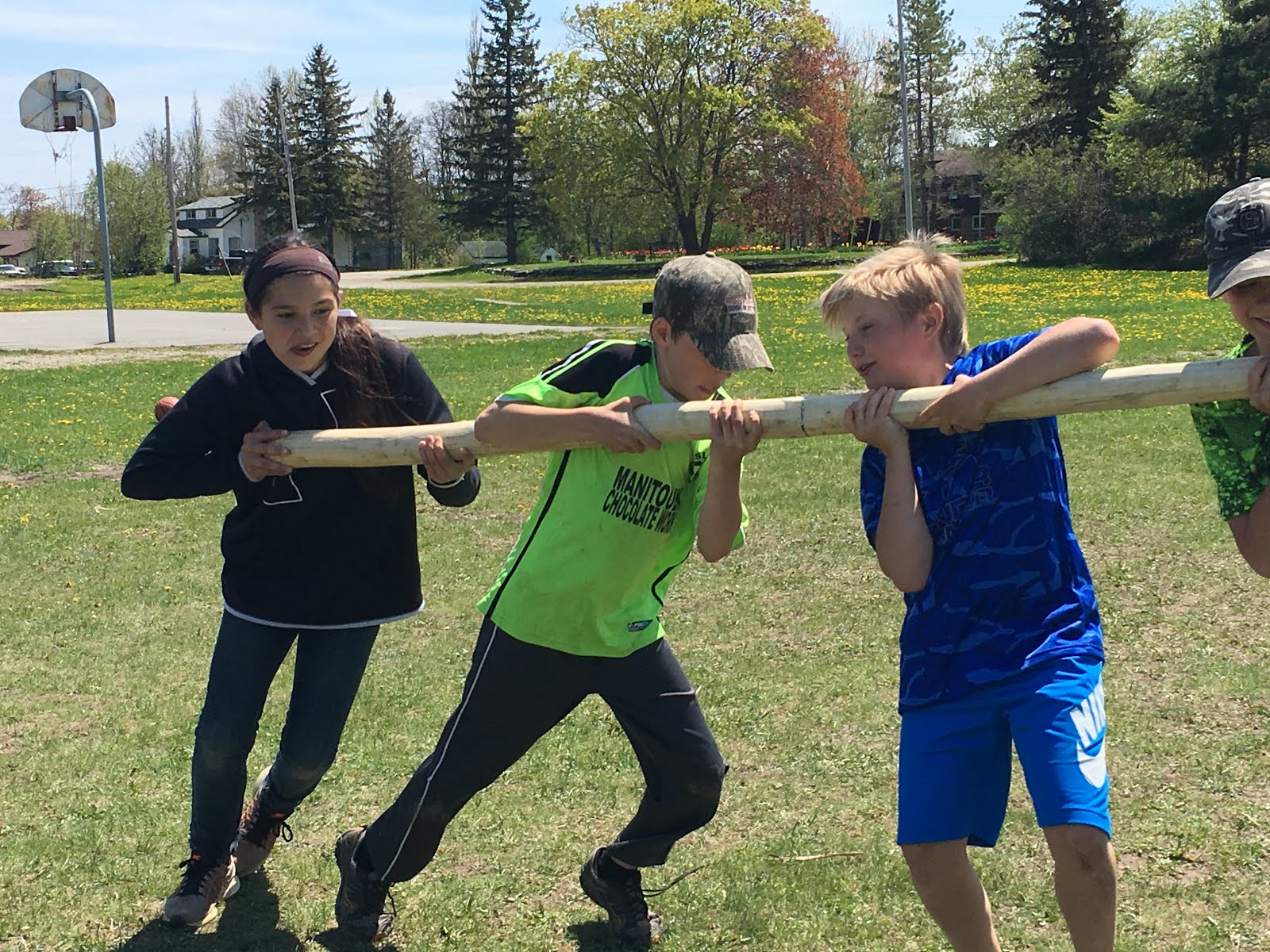
Steven Pruchnicki and Dana Stevens of KenjegewinTeg Educational Institute instructed the students on the history of and how to play Indigenous Games.  The games included lacrosse, double ballk, pole push, stick pull, archery, and two-foot high kick.  The students had a lot of fun playing the games and are looking forward participating in the inaugural Manitoulin Indigenous Games.    


Wednesday, 10 May 2017

Leading a Discussion About Collaborative Inquiry With Our Colleagues


Primary teachers explore collaborative inquiry in the classroom.  They discuss successes, problems, and questions.  Working in small groups is examined.  The primary teachers also discuss strategies of how to work in small groups without interruptions and the value getting kids back together after the small group work time.  It is agreed that having students take their learning public and teach others is important. 

Junior and Intermediate teachers focus on literature circle inquiries.  The discussion begins with teachers sharing their own experience with book clubs or literature circles.  They identify successes, problems, and questions.  Teachers observe a literature circle in action and share what they notice about the students' interaction, social skills they see the kids using, and how students draw extensively from notes and their books.  Teachers discover that it is important to have students identify and research lingering questions rather than traditional after-the-book projects.

Tuesday, 11 April 2017

Ribbon Skirt Making


Alanna Trudeau and Kate Pitawanakwat shared their knowledge of the importance of the ribbon skirt with the students.  Alanna explained that the ribbon skirt has a connection to Mother Earth.  The bottom of the skirt touches the earth and let's the earth know who is walking on her back.  The skirt emulates the shape of the tipi.  Women wear the skirt to ceremonies and special events.


With the guidance of Alanna and Kate Pitawanakwat, students were able to design and create their own ribbon skirts.  We were also very fortunate to have Alice Pennie helping the students with sewing.   


Students took careful measurements and worked carefully to create their Ribbon Skirts.  They choose the colour of their skirt and ribbons.  Students were quite proud of their skirts and excited to wear them.

For more information, visit CBC Radio's Unreserved series Skirt Teachings with Myra Laramee.

Tuesday, 28 March 2017

Indigenous "Ways of Knowing"

We recently attended a math conference, with keynote speaker Dr. Lisa Lunney.  There, she talked about "Indigenous Ways of Knowing".  We often think of things like Pi as being something the Greeks discovered, and therefore, only they could understand it.  However, Dr. Lunney discussed how a Mi'kmaq elder in her community used a traditional method to make a perfect circle for her quillbox, using three lengths of wood strips and a thumb width...Pi, anyone?  Her blog, Show Me Your Math, looks at how these traditional "Ways of Knowing" can be incorporated into the classroom.

My main takeaway from the conference had to do with the idea of not always focusing on Eurocentric knowledge in topics like math.  After all, the Indigenous people of this land used math in THEIR everyday lives, too.  Whether it was to determine how much food was "enough", how to create intricate patterns, or how to build a dwelling, people living in North America prior to the arrival of Europeans relied on their own mathematics, developed over generations.  I believe that these understandings should be celebrated.  The First Peoples of this land survived treacherous winters and untold perils, which is a testament to their knowledge and wisdom...and is worth teaching to our younger generations!

Thursday, 16 February 2017

Outdoor Learning

It is important to get out of the classroom and enjoy the outdoors.  We were very fortunate to visit a nearby hiking trail at McLean's Park for orienteering and snowshoeing. 

The benefits of being outdoors include:

  • Physical exercise.
  • Refining motor control
  • Learning about the natural environment and the creatures that inhabit them.
  • Providing calm and focus.
  • Learning is more memorable and engaging.


Wednesday, 25 January 2017

Wonder Wall


In my kindergarten classroom, my students were always making "I wonder ..." statements.  I noticed that my grade 5/6 students did not.  In an effort to encourage my students to wonder we began "Wonder Wednesdays".  I got the idea from Collaboration and Comprehension by Stephanie Harvey and Harvey "Smokey" Daniels (I love this book!).

Students are invited to post any inquiry questions, even off-task questions, on a post it note and affix it to our Wonder Wall.  On Wednesdays we take 15 - 30 minutes to address our wonder questions.  The students are already demanding more time for their wonders.

Wonder Walls are a great entry point for those who are not yet comfortable with inquiry.